

By Dennis Ndlovu|Zim GBC News
The International Monetary Fund (IMF) has indicated that the current stability of Zimbabwe’s gold-backed currency, the ZiG, is largely the result of significant intervention by the Reserve Bank of Zimbabwe (RBZ), rather than underlying economic fundamentals.
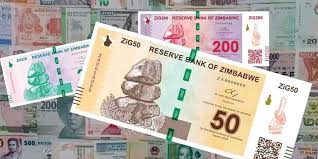
The ZiG was launched in April last year, marking the country’s sixth attempt in more than ten years to establish a reliable domestic currency.
Despite its introduction, the ZiG remains scarce in circulation and has yet to gain acceptance within the informal economy, which constitutes a major portion of Zimbabwe’s economic activity.
The IMF has expressed concern that the official exchange rate is artificially maintained and not reflective of true market dynamics. The Fund observed that monetary base expansion for the ZiG decelerated to roughly 30% between October 2024 and April 2025.
This deceleration has contributed to a period of relative stability in both the official willing buyer-willing seller (WBWS) exchange rate and the informal market, with rates fluctuating between US1:ZiG25–ZiG28 officially and US1:ZiG32–ZiG36 on the parallel market in recent months.
However, the IMF’s 2025 Article IV Consultation report, published last week, cautions that this apparent stability masks a deeper misalignment in the value of the ZiG. The Fund stated:
“The RBZ continues to dominate the WBWS market, managing the exchange rate within a tight band through foreign exchange interventions financed by increased surrender requirements raised to 30% in February 2025 to strengthen intervention capacity and bolster reserves.
“Market feedback indicates a reduction in unmet foreign currency demand, and the RBZ has commenced rebuilding its foreign currency reserves, aided by a stronger current account. However, total international reserves remain critically low at US$683 million as of late May 2025—equivalent to less than one month’s import cover.
“Our analysis suggests that the external sector remains weaker than what is consistent with macroeconomic fundamentals and optimal policy settings.”
The IMF further noted that the exchange rate does not adjust adequately to increased demand for foreign currency when the RBZ steps back, as market players continue to anticipate central bank intervention to sustain the current rate.
The IMF said, “Exchange restrictions and capital flow measures (CFM) also interfere with the working of the FX market, including the increase in surrender requirements.”
The IMF said that scaling back the RBZ’s presence and easing restrictions in the foreign exchange market would allow the ZiG to reach its true value. It said:
“Establishing a market-determined exchange rate requires reducing the RBZ footprint in the FX market by gradually redirecting surrender requirements into the market through authorised dealers and eliminating market barriers from exchange restrictions, in line with the IMF’s latest Article VIII recommendations.
“This is essential to make the exchange rate an effective intermediate target. It will also help narrow the gap between the WBWS and parallel market rates, bolstering confidence in the ZiG and reducing economic distortions.
“In the longer term, a comprehensive package of macroeconomic, financial, and structural policies should allow for a gradual relaxation of CFMs.”
The IMF urged the RBZ to adopt a more transparent, market-based foreign exchange system and implement a clearer, more consistent monetary policy framework.
“A credible monetary and FX policy framework is essential to establish the ZiG as a stable and more widely used national currency,” The IMF said:
Stay Connected with Zim GBC News:
- X (Twitter): @ZimGbc
•Instagram: @ZimGBCNews
•TikTok: @ZimGBCNews_01
•Facebook: Zim GBC News
•YouTube: Zim GBC News
Get real-time alerts on WhatsApp:
+263 773 820 323
For in-depth coverage, visit our website: www.zimgbcnews.co.zw
Zim GBC News | Global News From An African Perspective©2025
All rights reserved.