

Tembani P. Thebe Science and Technology Reporter www.zimgbcnews.co.zw
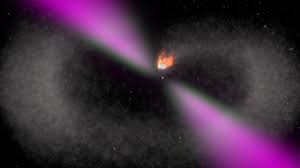
In a cosmic revelation that pushes the boundaries of planetary science, the James Webb Space Telescope (JWST) has identified an exoplanet with a carbon-rich atmosphere orbiting a volatile “black widow” pulsar, a rapidly spinning neutron star that is methodically consuming its stellar companion.
The landmark discovery provides unprecedented insight into the formation and potential habitability of planets in the most extreme environments imaginable.
Scientists analysing the data are calling it a window into a previously unseen class of planetary bodies.
“This is a truly extraordinary find that challenges our conventional understanding of where planets can form and what they can be made of,” said Dr. Anya Sharma, an astrophysicist at the Cosmic Research Institute and a lead scientist on the study.
“To find a planet not just surviving, but thriving with a unique chemical signature in the violent vicinity of a pulsar, forces us to rethink the processes of planetary evolution.”
The discovery was made possible by the JWST’s unparalleled infrared sensitivity. By meticulously analysing the starlight that filtered through the exoplanet’s atmosphere during its transit, its spectrographs detected the unmistakable signature of abundant carbon-based molecules.
“Webb’s precision is like reading a fingerprint in the dark from thousands of light-years away,” explained Dr. Sharma.
“The data tells us this atmosphere is profoundly rich in carbon, a fundamental building block of life. While this doesn’ mean we’ve found life, it reveals the type of chemical diversity that exists out there, which is the first step in that search.”
Black widow pulsars earn their name from the nature of the binary system, where the intense radiation and gravitational pull of the super-dense neutron star slowly evaporate and strip away material from its closely orbiting companion star.
This destructive yet creative process can, in rare cases, provide the raw materials for planet formation in the stellar aftermath.
“We are witnessing a cosmic dance of creation and destruction,” commented Professor Benard Ochieng, an astronomer not directly involved with the study.
“The pulsar is the black widow, consuming its partner, but from that same environment, we now see it may also spin a web capable of crafting entirely new worlds with exotic characteristics. This discovery by Webb confirms that planetary systems are even more diverse and resilient than we ever imagined.”
The detection of this carbon-rich world opens new avenues for research into planetary formation under extreme conditions and expands the search for habitable environments beyond traditional star systems.
As the James Webb Space Telescope continues its mission, scientists anticipate it will unveil further secrets of exoplanet atmospheres, potentially uncovering more worlds that defy expectation and deepen our understanding of the universe.
Follow Zim GBC News on Social Media:
·X (Twitter): @ZimGbc ·Instagram: @ZimGBCNews
·TikTok: @ZimGBCNews_01 ·Facebook: Zim GBC News
·YouTube: Zim GBC News
Get real-time alerts on WhatsApp:
+263 773 820 323
For in-depth coverage, visit our website: www.zimgbcnews.co.zw
Zim GBC News | Global News From An African Perspective©2025