

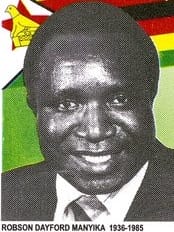
Early Life & Radicalization
Born in 1945 in rural Matabeleland, Robson Manyika grew up under the oppressive Rhodesian system. Educated at missionary schools, he developed early political consciousness and joined ZAPU in his late teens, inspired by Joshua Nkomo’s vision of armed resistance. His sharp intellect and leadership qualities quickly marked him for greater responsibility in the liberation movement.
Military Ascendancy in ZIPRA*
Manyika received advanced military training in both Zambia and the Soviet Union, where he mastered:
- Conventional warfare tactics
- Guerrilla insurgency strategies
- Political mobilization techniques
As a senior ZIPRA commander, he served directly under Alfred Nikita Mangena in developing ZIPRA’s unique hybrid warfare approach that combined:
- Soviet-style conventional military tactics
- Classic guerrilla warfare
- Sophisticated political education programs
Pivotal Military Campaigns
Manyika planned and executed several decisive operations:
- The Wankie Campaign (1967-68)
- Joint operation with ANC’s Umkhonto weSizwe
- Established first permanent guerrilla presence in Rhodesia
- Tested ZIPRA’s conventional warfare capabilities against Rhodesian forces
- The Victoria Falls Front (1972-75)
- Created crucial infiltration routes from Zambia
- Established rebel governance in rural Matabeleland
- Disrupted Rhodesian supply lines to the west
- Operation Mardon (1976)
- Coordinated attacks on Rhodesian military outposts
- Successfully ambushed Rhodesian patrols in Lupane
- Demonstrated ZIPRA’s growing military sophistication
Political Leadership & Diplomacy
Beyond the battlefield, Manyika:
- Led ZAPU diplomatic missions to Moscow and Havana
- Helped negotiate Soviet and Cuban military support
- Advocated for ZAPU-ZANU unity (though ultimately unsuccessful)
- Developed ZIPRA’s political education curriculum
Mysterious Death & Legacy
Manyika died under suspicious circumstances in 1979, just months before independence. While officially attributed to illness, many veterans believe:
- He may have been poisoned by Rhodesian agents
- His death conveniently removed a key ZAPU strategist
- It weakened ZIPRA’s position in the transition to majority rule
Today, Manyika represents:
- The lost potential of ZIPRA’s military strategy
- The marginalized narrative of ZAPU’s contribution
- The untold stories of second-tier leaders who shaped the struggle
Historical Significance
Manyika’s innovative hybrid warfare approach demonstrated that:
- African liberation movements could master complex military strategy
- Political education was as crucial as military training
- The liberation struggle required both battlefield and diplomatic victories
His legacy continues to inspire discussions about alternative paths Zimbabwe might have taken had ZIPRA’s leadership survived the transition period intact.
Zim GBC News©️2025