

South African Correspondent
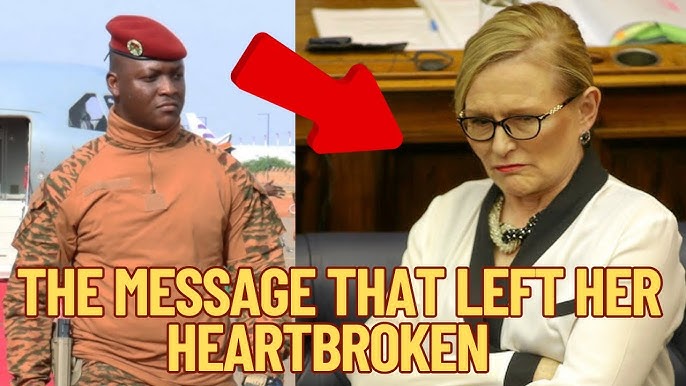
JOHANNESBURG — In a striking moment that has sent shockwaves through Africa’s political landscape, Burkina Faso’s revolutionary leader, Captain Ibrahim Traoré, confronted South Africa’s Democratic Alliance (DA) Federal Chair Helen Zille during a high-profile pan-African summit.
The exchange occurred after Zille criticized the “anti-Western posture” of certain West African states and their alignment with what she termed “non-democratic alliances.”
Speaking on behalf of the DA, Zille urged for enhanced cooperation with Western democracies, warning against what she described as a “dangerous slide into populist militarism.”
However, before she could finish her remarks, Traoré seized the microphone, delivering a passionate rebuttal that left the audience—and Zille—stunned.
“We will no longer be lectured by those who once imposed chains on our ancestors and now wish to dictate the terms of our freedom,” Traoré declared, his voice resonating with conviction.
“The DA may dress itself in liberal language, but we see through the tailored suits and polished accents. Africa is not a pupil. Africa is a rising voice—and we will speak for ourselves.”
Zille, known for her assertive demeanor and ideological confidence, appeared visibly taken aback by Traoré’s directness. Witnesses described her expression as “frozen,” and she reportedly reached for her notes but did not speak again for the remainder of the session.
Traoré continued his impassioned address, criticizing what he termed the “selective outrage” of political elites in Southern Africa.
“Where was your outrage,” he asked pointedly, “when our gold was plundered, our leaders assassinated, and our youth left to drown in the Mediterranean while the world watched? Now that we speak of sovereignty, we are called extremists? No, Madame Zille. We are reclaiming what was stolen—our land, our pride, and our power.”
The room erupted in applause, with several West and Central African leaders nodding in agreement. Even attendees who had maintained neutrality throughout the proceedings could not ignore the force and clarity of Traoré’s words.
Zille, who has faced increasing criticism in South Africa for the DA’s perceived Eurocentric stance, has yet to issue a formal response to the incident.
DA spokespersons characterized the moment as a “misunderstanding of context,” while some within her party privately acknowledged that the exchange “did not land well.”
Traoré’s bold stance reflects a broader movement gaining momentum across West Africa. Leaders from countries such as Mali, Niger, and Burkina Faso are increasingly embracing anti-imperialist rhetoric and advocating for an Africa-first political order.
This shift draws inspiration from revolutionary figures like Thomas Sankara and Patrice Lumumba, who championed self-determination and sovereignty for African nations.
As the political landscape in Africa continues to evolve, Traoré’s remarks resonate with a growing sentiment among many Africans who seek to redefine their relationships with former colonial powers and assert their independence on the global stage. The incident at the summit underscores the tensions between traditional political alignments and the rising call for a new, assertive African identity.
Zim GBC News©️