

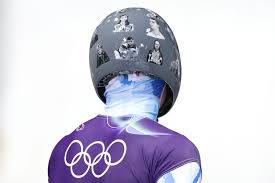
Zimbabwe’s IOC President personally intervened to broker compromise but Ukrainian slider refused to back down, now faces disqualification from Milano Cortina 2026
Friday 13 February 2026
Zim GBC News | Sports Correspondent
CORTINA D’AMPEZZO, Italy – Zimbabwe’s most decorated Olympian and current International Olympic Committee President Kirsty Coventry found herself embroiled in a deeply emotional dispute at the Milano Cortina 2026 Winter Games on Thursday, after a Ukrainian athlete was barred from competition over a customised helmet honouring slain compatriots.
Ukrainian skeleton athlete Vladyslav Heraskevych was disqualified from the men’s skeleton event after refusing to remove images of Ukrainian athletes killed since Russia’s full-scale invasion from his helmet. The 27-year-old, who carried his nation’s flag at the Opening Ceremony, had used the helmet during official training but was informed it violated Article 50 of the Olympic Charter, which prohibits political statements on the field of play.
Coventry, who travelled to Cortina specifically to meet Heraskevych and his father Mykhailo, described the encounter as an “emotional morning” and expressed disappointment that a compromise could not be reached.
“They took the time to come in and talk with me this morning. I was not meant to be here, but felt that it was really important to come and talk to him face-to-face,” Coventry said.
“As you’ve all seen over the last few days, we’ve allowed for Vladyslav to use his helmet in training. No-one — no-one, especially me — is disagreeing with the messaging. The messaging is a powerful message of remembrance, it’s a message of memory, and no-one is disagreeing with that.
“The challenge that we are facing is that we wanted to come up with a solution for just the field of play. I know he’s very quick, so for just two minutes to not wear the helmet on the field of play.”
‘I will not betray them’ — Athlete stands firm
Coventry proposed an alternative arrangement whereby Heraskevych’s helmet could be displayed and honoured before and after his race, noting that the athlete himself acknowledged the imagery was “blurry” during high-speed descents.
“I said OK based off that could we find a solution where we pay homage to his message, to his helmet before he races, then as soon as he’s finished racing going into the mixed zone where you can see the pictures, because he’s very right, it would be blurry going down, so could we find another solution where the memories could be honoured in a wonderful way?
“Sadly, we’ve not been able to come to that solution. I really wanted to see him race today. It’s been an emotional morning.”
Heraskevych, however, remained resolute, vowing he would not betray fallen compatriots.
“These athletes sacrificed their lives and because of this sacrifice I am able to be here so I will not betray them,” he said.
While acknowledging that Olympic medals had been his dream since childhood, he stated:
“In this time of full-scale war some things are really more important than medals.”
‘Emptiness’ and allegations of discrimination
Following his disqualification, Heraskevych described an overwhelming sense of loss.
“As I understand, here we have channels who have some TV rights. I believe we had a final training run and I encourage you to put it on screen after races finished, after others get their moment, after the last sled, put my final training run on the screen. Just to honour athletes pictured on this helmet.
“I believe they deserve this moment. Certainly I do not get my moment at this Olympics, despite I would say pretty good results in the training runs. I really believe we could be among the medallists today and tomorrow, but we will not be able to race.”
The Ukrainian athlete accused the IOC of inconsistent application of its rules, pointing to other competitors who displayed messaging without sanction.
“US figure skater, Canadian freeskier, Israeli skeleton athlete who is also here today, they didn’t face the same things. So suddenly just a Ukrainian athlete in this Olympic Games will be disqualified for this helmet which is not violating any rules.”
Heraskevych indicated he is preparing to challenge the decision.
“I believe we need to continue to fight for our rights. I told you from day one that I do not agree with what the IOC says to us, so probably we will prepare a CAS case and we will defend our rights in CAS.”
‘The field of play is sacrosanct’ — IOC defends position
The IOC has maintained that Rule 50 Guidelines were developed to protect the neutrality of sport and were informed by a 2021 global consultation involving 3,500 athletes.
Earlier this week, IOC spokesperson Mark Adams referenced the case of American figure skater Maxim Naumov, who honoured his parents during competition, as an example of permitted expression.
“It’s a very emotional, very human, spontaneous human gesture. In a sense it highlights what we are saying, this Ukrainian athlete, he can do the same. And we have loosened the rules — we are offering him to wear a black armband to commemorate his friends and colleagues who’ve lost their lives. But for us, and for the athletes more importantly, the field of play is sacrosanct.”
In a formal statement, the IOC added:
“Mourning is not expressed and perceived in the same way everywhere in the world. In order to support athletes in their mourning, the IOC has put in place multifaith centres in the Olympic Villages and a place of mourning, so that grief can be expressed with dignity and respect. There is also the possibility to wear a black armband during competition under certain circumstances.
“During the Olympic Games athletes are also offered a number of opportunities to mourn and express their views, including in the media mixed zones, on social media, during press conferences and in interviews.”
Coventry caught between rules and empathy
For Coventry, the dispute represents an early and deeply personal test of her presidency. Having assumed the role as the first woman and first African to lead the IOC, she now finds herself balancing rigid regulations against the raw emotions of athletes competing amid war.
No further comment has been issued by the Zimbabwean’s office since Thursday’s exchange.
FOLLOW US FOR REAL-TIME UPDATES:
· X (Twitter): @ZimGbc
· Instagram: @ZimGBCNews
· TikTok: @ZimGBCNews_01
· Facebook: Zim GBC News
· YouTube: Zim GBC News
Get real-time alerts on WhatsApp:
+263 773 820 323
Zim GBC News | Global News From An African Perspective©️2026